
An open web page consisting of information supplied by ex crewmembers
and fiends of the USCGC Taney. Please submit your name and or story to
the Webmaster vern@armory.com
USCGC TANEY Reunion update 15-18 October 1998 Quality Resort 5 Hotel Circle South San Diego. Reservation Phone 1-800-362-7871 or contact:
Harry & Delores NELSON
18327 Van Ness Ave
Torrance, CA 90504-5309
310=324=7282
We wish to thank Harry & Delores Nelson for a great reunion, over 26 shipmataes attended along with many friends of the Coast Guard.
Our next reunion is not yet set, we need volunteers, suggestion East Coast in year 2000, near some Coast Guard Support.
USCGC TANEY another Smithsonian??
It seems when a person is assigned to a ship or station they should
first check into the background of the person that ship or station is named
after.
A few years ago I attended a very emotional decommission of the Cutter
Taney and was proud to see it turned over to the Baltimore Maritime Museum.
The Taney was built as a High Endurance Cutter along with six other
sister ships in 1936, by the Treasury Department, and all the
ships were named after former Secretary of Treasure's. The Taney
is the last military ship afloat that saw action at Pearl Harbor and she
went on to serve for over fifty years which included Korea and Vietnam.
At our reunion the Taney's last skipper brought some distressing news.
By order of the Mayor of Baltimore, MD the Coast Guard name and logo
and other identity marks were painted out and the ship moved to another
location. After several tries the skipper received a fax stating
they wanted to emphasize the ship's pre war duty. Other former crewmembers
received two other versions. One was that ships namesake R. B.
Taney who later became Chief Justice, participated in the Dred Scot infamous
(slavery) decision. The other reason was that the U.S. Coast Guard
represented drug bust. The politicians of Baltimore did not like seeing
the ship in prominent view. (more info on my web page http://www.armory.com/~vern/
history +.
"Seek not to punish the past but to enlighten the future" vern
Story by Warren Hartman 1996 Copied by Vern Toler Sep 1989
Ahoy: I'm Warren Hartman and I wrote the first book complete with mistakes!!
U.S.S. Taney, W37. Keel laid in 1936 with 6 sister ships.
She was decommissioned in 1986 after 50 years of service.
She was assigned to the Hawaiian Sea Frontier in 1937.
During Taney's career, she steamed near 1 million miles.
She served in WW2, Korea, and Viet Nam earning 11 battle stars.
She is the only Pearl Harbor combat ship still afloat.
She served as Flagship, Atlantic convoys in 1943 and 1944.
Also served as Flagship in Pacific Theater, Okinawa 1945.
Took hits and fragments from Luftwaffe in North Africa 1944
Took hits and fragments, Okinawa 1945
Took hits, shore batteries, Viet Nam
She was at the start and finish of WW2
Was awarded the big E in 1943
Received praise letters and accommodations from two Admirals..
She was termed 'Luck Lady' = I believe "Blessed"
"Praise the Lord and Pass the Ammunition" our timely theme song.
\U.S. Coast Guard enlistment's soared to near 300,000 by 1945.
Taney performed many varied duties.
Interdiction and boarding parties in war and peace time.
Search and rescue in war and peace time.
Served as A.P.D. Landing Assault Ship.
Served as Flag ship in both theaters of war.
Gunfire support with 3rd fleet.
Convoy and Picket duties both theaters of war.
Weather ship - peacetime.
Salvage assistance - peacetime.
Ocean station VICTOR - peacetime.
Drug abatement surveillance - peacetime
Taney is now a National Landmark at the Baltimore Maritime Museum
A ship is only as efficient as its crew. Are there any "Plank Owner's " aboard?
God Almighty, we thank you for protecting our ship and guiding her crews through the years. In Jesus' name AMEN ALOHA
Harry & Delores NELSON
18327 Van Ness Ave
Torrance, CA 90504-5309
COMMENDATIONS
26 August 1945
To:
OFFICERS & MEN OF MY FLAGSHIP USS TANEY C.G.
You have done excellent work under difficult conditions, adjusted to situations not according to plans, and contributed to the overthrow of the enemy - You may well be proud!
Your response to my demands were far in advance of my expectations and hopes accomplishing. May God bless you all.
Sincerely
Rear Adm. C. H. Cobb
U.S. Navy 3rd Fleet.
It is logged that Commander Hunt called Taney "Indestructible"
Capt. Frick stated: "The best command at sea I had"
Capt. Olson quipped: "She may outlive us all. Surely her spirit will"
1946
"During the war the United States Coast Guard earned our highest respect and deepest appreciation of the Navy and Marine Corps.
It's performance of duty has been without exception, in keeping with the highest traditions of our Naval Service"
Secretary of the Navy
James Forestall
September 1953
U.S.S. Taney C.G. is listed with other ships receiving engagement stars, indicating her support role in Korea with the 7th Fleet.
12 February 1970
TO:
CREW USS TANEY, COAST GUARD
Vice Admiral W. Bringle, Commander 7th fleet wrote "Taney's Exemplary Performance while on Operation Market Time Vietnam, was indicative to the dedication, flexibility, and professionalism of her fine crew."
BRIEF HISTORY OF U.C. COAST GUARD
During World War 2 our personnel grew to near 300,000 and we manned some fifteen hundred ships and stations in all theaters of war. The types of ships varied from 30,000 ton attack transports to 5 ton assault crafts requiring many new skills to learn.
Our major duties included are:
During the Normandy invasion, sixty of our 83' picket boasts saved over 600 lives. On December 7, 1941 we had about 400 personnel covering the Hawaiian Sea frontier along with one major cutter, two large tenders, two rescue vessels, five patrol boats and one fire tug. Our peace time surveillance covered an area west to Midway , south to Samoa, and the Society group on the line islands covering 5800 sea miles.
In 1942 we started establishing Search and Rescue stations on land and on the sea. LORAN stations (Long Range Navigation Signal) also were installed and by 1945-46 stations were in service. They covered Johnson, Midway, Ulithi, Iwo Jima and Yap Islands. By 1960, the LORAN chain had stretched to Iceland, Ireland, Gibraltar, Grand Banks, and Japan. This low frequency transmitter sends out a homing signal up to 800 miles by night and 1,600 miles by day. This was twice the distance and accuracy of previous systems and was a highly guarded secret. Only allied ships and planes had special equipment to receive this signal and was a real blessing for navigation in bad weather.
Reflecting back to 1790. Alexander Hamilton officially established the "Revenue Cutter Service" hoping to halt the slaves, pirates and law breakers, This was the start of today's Coast Guard, but the real beginning started in England in the year 1711 when they developed fast sailing cutters for law enforcement, these were privately lowed and manned by civilians. This often led to bloody combat against law breakers. Historically we copied their uniform, terminology and customs.
By 1792, our American armed cutters had well trained uniformed crews and a growing deterrent against pirates who plundered American merchant ships. By 1830, our U.S. Cutter Service had a large fleet of ships of up to 170 feet and well gunned, serving the wars of 1812 to the present.
By 1776, our U.S. Navy was officially born through Congress and around 1802 had a fleet of 49 vessels including the "USS Constitution" with 36 guns that greatly aided in the control of the seas. In 1915, Congress renamed the U.S. Coast Guard" and we took over the U.S. Lighthouse Service and the ships that had been established 50 years previously.
Hundreds of civilian yachts and crafts were loaned to us for the duration of the war, which we armed and manned. Some 11,000 women enlisted (named S.P.A.R.S.) During the 40's serving in many capacities and women now are still a permanent part of this service.
Beach patrols saw horse mounted armed Coast Guard personnel with K-9 dogs encompassing America's shores during WW , Iceberg surveillance by cutters were replaced by satellite in the 70's and manned lighthouse keepers were replaced by automation.
Lifeboat surf stations have gradually been replaced since the 50'd, by air bases. The Air Wing of the Coast Guard had increased ten-fold since the 50's , having pioneered helicopter rescues. Their fixed wing fleets are invaluable with the inset of drug abatement.
We have seen duty and many coast of the world since 1790
S/Warren
Oct 11 1994 Pear Harbor Survivors Association, Inc. Page 3
WARREN HARTMAN SHARAES REMEMBRANCES:
RECALLLING the 1940's
No gum or wooden matches aboard ship -- Only the Boson's whistle -- Steaming moonless nights trailing a florescent wake. A 4" swastika painted on the bow while chipping the anchor -- Holy stoning the teakwood decks at 6 a.m. Sleeping on deck hot nights -- White glove and sea bag inspections -- Pressing our uniforms under G.I. mattresses -- Surf landings in a 22' whale boat -- Gooney birds so thick on atolls walking was difficult --0 Blueberry Hill, " You are my Sunshine, Jersey Bounce, San Antonio Rose" on all the jukeboxes -- Dungaree and Aloha shirt liberties -- Sick Bay's APC cure-all pills-- Sea stores cigarettes at $1.00 a carton.
2 Jan. 1943 At this time USS TANEY CG had steamed ¼ million miles in the Pacific theater, since launch in 1936 and working convoy picket duty on the outer ring. This was an uneasy station and had alerted three general quarters calls within twenty-four hours.
21 Feb. Our sister ships SPENCER % CAMPBELL had sunk two subs in the Atlantic & with the historically bad weather; we termed it "hard duty". We continued convoys in Central Pacific. (The Hamilton sank earlier in the Atlantic.)
20 Aug. We arrived at Alameda shipyard for modification, noting that the mascot SOOGIE had been aboard for 5 years. Thirty-day leaves were granted!
4 Mar 1944 We cleared the Panama locks on the Atlantic side with our progress reduced to 8 knots while escorting a damaged D. E. to Boston. TANEY continued drills and shakedown of our new fire control system.
13 April We were now "FLAGSHIP" and assigned to Task Group 66 after having a combat information center installed at Boston. Scuttlebutt reached us that the Azores Islands were a sanctuary and refueling depot for enemy "U. BOATS", also an interception point for our convoys to Africa.
Liberators & P. B. Y.’s flew relentless convoy patrols (weather permitting). The Maderian Island area, some 300 miles south of our convoy, lane to Giberaler was termed a "spring board" for WOLF PACKS which had sunk 1,000,000 tons of shipping in 1942. Japans "I boats" assisted the German Navy, from Africa’s west coasst through the Indian Ocean campaigns.
All this threatening news was hi lighted by the Luftwaffe offensive vectoring out from Algeria bases on night attacks.
20 Apr. Too soon the fears were realized when our UGS38 convoy of 85 ships consisting of 3 British subs, 17 destroyers & D. E.’s was attacked by German night fighters from Algeria bases, dropping torpedoes, sinking and damaging 6 ships. The subs took the heaviest toll.
23 Apr. We were relieved by British escorts & the total cost was 1,100 dead and 150 wounded. FLAGSHIP TANEY was once again "lucky" with only superstructure damage & 4 wounded. Our convoy loss was below 16% we heard!
In forward areas our chaplain served communion upon request, stabilizing fears, giving strength to those who thirsted.
WARREN
OKINAWA
10 Feb. 1945 USS TANEY CG proceeded with 4 other destroyers from Boston to Pearl for repairs & new communication gear.
24 March We arrived Ulithiatol with Admiral Cobb aboard and now teamed "Flagship Amphibious Force".
11 April We arrived at Okinawa with task force 51 proceeding to Hagushi landing beaches. An air alert existed causing total confusion to our groups.
16 April Strong enemy attacks continued by air & our combined gunfire downed many Kamikazes.
25 April Minor attacks now continued but destroyers on radar picket duty (outer duty) received the heaviest punishment. On the 26th (weather clearing) we received a creditable amount of flack but our command station was supported by Corvettes, D.E.'’ & L.S.T.'’.
28 April Task Force 51 was bombarding shore installations & Japanese suicide boats had been reported in our area-submarines were a constant menace to us.
8 May V.E. Day, as war in Europe was nearly over our theme song was "Praise the Lord and Pass the Ammunition" – luck was still holding!
26 May Suicide plane attacks increased and a torpedo launched at us, cleared our stern, hitting a L.C.I. During the preceding 45 days TANEY went to G.1. 119 times and standing at battle stations as long as 9 hours at a stretch. Scuttlebutt has it that sister ships INGHAM, BIBB, & SPENCER had arrived with the 5th fleet off Corregidor!
22 July From April through July attacks continued & it sunk 34 vessels, damaged 368, & upwards of 9,940 casualties.
Ships mechanical problems could more easily be repaired then personnel problems which caused arguments from battle fatigue. Records showed that 66% of the crew had 26 months of "hard duty" time!
24 July We moved along side of sunken Japanese ship with only superstructure showing. The stench of oil, fire, & of death was revolting.
1 Aug. TANEY led task unit 95 to sea to avoid a tropical storm, returning to Bunker Bay on the 3rd. This year was bad for storms.
4 Aug. Both anchors were extended to 80 fathoms, and creeping power
was maintained through the storm.
14 Aug. THE WAR IS OVER!!!!
11 Sept. We arrived at Wakayama through mine fields. We anchored in 18 fathoms. Engineering reports stated that the boiler tubes were leaking. A typhoon hit us on the 18th and 3 ships sunk, 139 planes destroyed & 780 men were missing. We only lost one anchor and chain – Many believe we are blessed. Vice Admiral W. Bringle, Commander 7th Fleet, wrote, "TANEY’s exemplary performance while on Market Time was indicative of the dedication, flexibility and professionalism of her fine crew".
KOREA 1950
June President Truman directed 6 heavy endurance Cutters to duty in Korea. TANEY’s previous cold weather expeditions proved invaluable, and again her armament was upgraded.
16 Aug. Arrived, Inchon, Korea, for duty with the 7th Fleet in the Formosa Straits, consisting of one carrier, one cruiser, and seven destroyers.
20 Aug. W37 assigned special duty patrols (S&R) between Guam and Japan, also station 2 off Okhatsk Peninsula.
The Korean Coast covers over four thousand miles of rugged mountains, encompassing hundreds of islands, containing numerous inlets, harbors and straits: From a Naval stand point, navigation and landing assaults were of high risk due to 25 foot rip tides on the Eastern shores.
During January in the Northern latitudes, average air temps are 17 degrees causing shipboard icing problems, with seawater recordings at 34 degrees.
Picket duties for W37 continued through winter and into next fall on Station 2.
7 Oct. Wosan Harbor, North Korea.
Path cleared through heavy mine fields by sweepers from Task Force 96, Japan.
Nov. Frogman and Commandos were off-loaded by H.E.C.’s, converted to A.P.D.’s, supporting beachhead assaults on enemy installations in less than 3 fathoms.
Dec. 100,000 Americans and Allies established beachhead at Wosan against devastating rip tides, and currents. New LORAN chains were established about Japan, Formosa, Korea, and the Philippines, along with stations from WW2. Large, self contained trailers housed this equipment, eliminating construction and expediting commissioning.
1951
4 July Statement at the 38th parallel.
TANEY continued a support role at her assigned stations, with occasional R&R in Yakosuka. This meant 5 days in port for re-supply, and 23 days at sea, each patrol. Other S.A.R. stations were established in sea blocks, with 4. H.E.C.’s patrolling Formosa, Philippines, Guam, and Wake to name a few, rescuing some 26 downed pilots, during the campaign, No declaration of War existed in this police action, Generating frustration among G.I.’s
1952
Jan. Winter icing, gale winds, and snow flurries complicated "Special Duties", in the Northern Latitudes of the Sea of Japan. Constant storms made shipboard life difficult.
Downed pilots had only minutes of survival time. Guns and deck machinery required constant maintenance. Records of rescue were above expectancy.
Feb. The U.S. NAVY is still off station of North Korea Coast, pounding inshore installations, with big guns. H.E.C.’s continue coastal shelling and interdiction of enemy naval assault forces, throughout the ensuring 18 months.
1953
July Truce signed – Navigator sets course stateside for de-arm.
WARREN
1969
VIETNAM
March TANEY MARU departed for Vietnam to be home ported at Subic Bay, Philippines, and assisted in operation "Market Time". Although, once again no declaration of War existed, her assignment was assisting the Navy in this police action for next year, with the 7th Fleet.
April The assigned M.E. and H.E.C.’s were deployed to Asiatic patrols, dispelling landings of men and arms, supplying the Vietcong guerrillas.
May The Monsoon season being on schedule and originating in Burma, bore torrential rains and winds, sweeping across the South China Seas to Darwin.
TANEY recorded several 56 degree rolls causing damage to radar screen and helo blades.
An accompanying escort vessel rolled upwards of 60 degrees, near capsizing, and taking sea water down its stack, thus aborting, due to power failure.
All ships in the South China theatre of operations were classified "un-operational" by naval Sea Command, since sustaining life aboard ship was imperative and at times doubtful!
Maintaining the barrier patrols consisted of inspecting over 1000 craft, and physically boarding 131 craft in search of enemy and contraband.
July TANEY fired 5,302 rounds during this tour, in support of South Vietnamese and allied forces, with one mission sustaining 5 hours of gunfire with other Squadron 3, H.E.C.’s inflecting heavy damage on shore installations.
August. TANEY performing A.P.D. duties but grounded in heavy fog while off-loading Frogmen and Commando’s for assault on land installations.
After backing down for near 1 hour she floated free of the incoming tide, once again no hull damage was encountered, but received fragments hits from coastal mountain batteries.
TANEY’s Log, documents that medical assistance was given to over 1200 South Vietnamese by her Doctor and Medic’s, being heloded ashore in many situations under enemy harassment, or fowl weather, or fowl weather, being termed "Operation Madcap", a timely name!
The village of Hoe Lac was a major treatment center receiving, 6 trips by TANEY’s Medical Team, via copter, within a 9 day period.
Sept. TANEY continued A.P.D. missions off-loading demo. Teams, under harassment, on Northern Vietnam installations throughout the year.
1970
Feb. W37 is reassigned stateside duty.
WARREN
THE USS ARIZONA IS THE ONLY SHIP STILL IN COMMISSION FROM THE PEARL HARBOR ATTACK.
THE USS TANEY CG IS THE ONLY FIGHTING SHIP STILL AFLOAT AND DOCKED AT THE NATIONAL HISTORICAL MUSEUM AT BALTIMORE, MD.
KNOWN AS W37 SHE CRUISED NEAR ¾ MILLION MILES EARNING 11 BATTLE STARS FROM WW2, KOREA AND VIETNAM, SURPASSED ONLY BY THE CARRIER USS ENTERPRISE, THAT CRUISED THE MILLION MILES AND WAS ENGAGED IN EVERY MAJOR ASSAULT.
IN MID 1942 USS TANEY CG WAS IN PEARL NAVY YARD FOR A NEW MAST AND RADAR ANTENNAE. SIGNALMAN 2ND, WILLIS PARTRIDGE (NOW COMMANDER U.S.C.G. RETIRED) WAS APPROACHED BY OUR NEW COMMUNICATIONS ENSIGN WHO CALLED HIM ASIDE AND SAID, "PARTRIDGE, WE ARE GETTING A NEW MAST TODAY AND SAILING AT DAWNS LIGHT, SO GET YOUR HALYARDS RIGGED AND READY FOR SEA" I ASKED "WHERE AM I GOING TO GET THEM AT THIS LATE DATE?" A SHORT PAUSE THEN, "AYE AYE SIR."
IN THE COMPANY OF QUARTERMASTER 1ST WE SET OUT TO FIND A SET OF SIGNAL BLOCKS AND DISCOVERED A LARGE BARGE LOADED WITH TRI POD MASTS AND FIGHTING TOPS OFF THE ARIZONA, HEADED FOR THE SCRAP YARD. I CHECKED WITH THE CIVILIAN IN CHARGE AND HE LET US HAVE NEAR A DOZEN BLOCKS WITH SISTER HOOKS.
MY ASSIGNMENT COMPLETED, THE TANEY WAS NOW EQUIPPED WITH PART OF THE ARIZONA, HIGH ALOFT ON THE YARD ARM.
I LEFT THE SHIP IN 1943 BUT WAS ALWAYS PROUD TO FEEL WE HELPED PART
OF THE ARIZONA RETURN TO FIGHT.
COMMANDER WILLIS PARATRIDGE USCG RETIRED
RECOLLECSTIONS OF THE USCGC TANEY, 1956-1957
By John A. Stone, Former ET2 April 13 1993
The Coast Guard in the Mid-1950's My Road to the TANEY
My time on the CGC TANEY was a 19-month period in 1956 and 1957. It was peacetime, not a period of high drama or national crisis. There was a Cold War going on with the USSR, but this seemed to have little effect on the Coast Guard, which had settled ;in to normal and routine operations following the Korean Conflict. The Coast Guard was part of the U.S. Treasury Department in those days, but we looked a lot like the U. S. Navy.
Our uniforms were Navy uniforms with; the addition of insignia to designate us as Coast Guard. Enlisted men, E-6 and below, wore the familiar "sailor suit", and white hat -- while chiefs (E-7 was the only grade of chief) wore a tunic coat, trousers, and cap, much like the officers' uniforms but without the gold braid. Everybody possessed both a navy-blue and white dress uniform, but the chiefs and officers also had an often-worn khaki version.
Many of the Coast Guard's vessels were converted Navy ships (but not the TANEY). Much of the installed equipment aboard all of our cutters was standard Navy issue. Close cooperation between the Coast Guard and the Navy was a fact of life, particularly in matters of supply.
Another fact of life for young men in those days was the Draft. For most men this meant that the odds were great of being required to spend two years in the military. Most accepted this as their fate and patriotic duty -- but few tried to get out of it altogether -- but there was nothing wrong with being "smart" and trying to arrange the best possible "deal" for oneself. For most there was a desire to influence the timing of the inevitable entry into active duty, and to choose the branch of military service. The Reserves were a popular option for achieving these goals. For me, The Coast Guard Reserve was my way of "beating the Draft" -- that is, of avoiding service in the Army at a possibly inconvenient time, by serving in the Coast Guard at a time of my choosing.
An indication that this was Indeed peacetime occurred in January 1955. The government decreed this as a cutoff date for Veterans Benefits ("GI Bill") eligibility. Those on active duty before the cutoff would get full benefits; those enlisting afterwards would not get these benefits. Needless to say, this led to a stampede of young men attempting to enlist in all branches of the Armed Forces before January 31, 1955. In my own case, Veterans Benefits were less of motivator than finishing school, so I delayed going on active duty until July 1955. Ironically, much, much latter, in the 1960's Congress in its wisdom restored Veterans benefits to those of us who had missed out on them, ;but not retroactively. Thus, I never received any education benefits after my service in the Coast Guard. But I did receive one good benefit that didn't cost the government a penny: I bought my first house in 1968 with a VA mortgage loan -- this meant no down payment and a favorable interest rate.
I joined the Coast Guard Reserve at age 17, in February 1953 when the Korean Conflict was still going on (although newly-elected President Eisenhower had promised to soon put an end to it). Coast Guard recruiters were still anxious to fill up reserve units with new recruits. My particular "deal" was an 8-year enlistment, to include at least two years of active duty. So I found myself going to weekly reserve meetings in Louisville, Kentucky, where I was living at the time. Meeting attendance and summer training keep up for more that two years, until I decided to fulfill my Draft and Reserve obligations by going on active duty in July 1955.
I received orders to report to 12th District in San Francisco for future assignment. After several weeks in California, I got my wish for electronics school and was shipped back across the country to the USCG Training Center, at that time in Groton, Connecticut. ET school was six months long, and I came out a newly minted ET3 on my way back to 12th District.
I had to wait a while, with some anxiety, as a transient at Base Alameda,
to learn what my permanent duty assignment would be. Eventually orders
came through to report to CGC TANEY! But I had to wait some more, because
in early April 1956, TANEY, was somewhere at sea. She returned to Base
on April 18, 1956, and that's when I reported aboard to began a very gratifying
experience as a crew member of the TANEY
The TANEY in 1956-1957
In 1956-57 the TANEY was based at Government Island (now called Coast Guard Island), Alameda, California. Her primary mission was Weather Station duty, which was rotated among the major cutters on the West Coast. I recall about a half-dozen Ocean Station NOVEMBER patrols during my tour of duty. The TANEY was always on standby for search-and -rescue or law enforcement missions, but I don't recall any such operations in this time period. Other operations included a month of Refresher Training with the Navy at San Diego and a two-week Reserve Training Cruise to Mazatlan, Mexico. There were two periods spent in shipyards around the Bay Area, including one of extensive maintenance in dry-dock. In those days, the TANEY had boilers and ran off of steam. For most of this period, the CO was Capt. James A. Alger, Jr., and the XO was Cdr. Morrell. I remember that Capt. Alger was a low-key individual, well-liked by the crew, and a superb leader-of men. He had a younger brother who also was a Coast Guard officer and who commanded a smaller cutter in the Bay Area -- I had the honor of serving under both of them at different times. The TANEY had a change of command in mid-1957, and Capt. Alger was transferred to the Coast Guard Academy. I can't recall the name of his successor as the CO of the TANEY.
A disclaimer -- I find that while I can recall the faces and personalities of the crew members, with only a; few exceptions their names are totally forgotten. Furthermore, I can't place events in chronological order or even say for a sure in which year they occurred. But everything I related did occur in 1956-1957.
I perceive moral on the TANEY to be quite high -- the officers treated us well, the chow was decant, and we spent at least two-thirds of our time in port. At sea, the ship rode well, everyone stayed quite busy, and most evenings there were movies on the fantail.
I worked in the electronics department, which consisted of a chief and two junior ET's, reporting to the electronics officer, who was Ems. Lynch. ETC Munson reported aboard in mid-1956, and I worked for him for most of my tour. He was tough, but we got along well. I worked with ET3 Jerry Starr until he was transferred and replaced by ET3 Walter Adams. I remember that Starr helped me buy my first automobile (most of the crew had cars at Base Alameda). Adams was married and had a family, so when the ship was in port he naturally wanted to spend as much time at home as possible; I often would standby for him when his section had the duty. -- I was single and lived on the ship, so it was no great hardship for me to do that. Walter was extremely talented as an electronics troubleshooter, much better than I was, and he sometimes got me out of jams when I was stumped trying to fix something. On one occasion, Chief Munson asked Adams and me to collaborate on a practical project of considerable difficulty, which we accomplished. This turned out to be a test for advancement, and both Adams and I were promoted to ET2 at the same time. In those days ET was an open rate, and promotions were made in the field.
The electronics Shop was a cubbyhole located on the second deck (same deck as the crew's mess and the wardroom), outboard on the port side just aft of the engine room spaces. We also had a stockroom located on a sub-deck only four feet high -- I spent a lot of time there, crawling around and sorting out spare parts We had responsibility for maintaining most of the electronic equipment on the ship -- radar's, fathometer, voice radio receivers and transmitters, radio-beacon -- with the notable exception of the high-powered main radio transmitters and receivers, which the RM,s wouldn't let us touch. One of the most interesting jobs was climbing the mainmast to work on a radar antenna -- I recall we had to do this once at sea, in a storm! In those days before solid state electronics, the equipment was full of vacuum tubes, and maintenance usually consisted of identifying which tube had burned out, and replacing it.
Life on Ocean Station NOVEMBER\
Ocean Station NOVEMBER was a point in the Pacific Ocean halfway between San Francisco and Honolulu, about 1200 miles from either city. The U.S. Coast Guard was responsible for having a ship on station at all times. The principal mission of cutters assigned to Ocean Station NOVEMBER patrol were to provide weather observations, a checkpoint for airline traffic, and, if needed, search and rescue capability.
Patrols at Ocean Station NOVEMBER were rotated among the for or five cutters from the 11th, 12th, and 13th Districts -- The West Coast. From Alameda, TANEY and GRESHAM pulled these patrols. Each patrol was about one month long: three weeks on station and about one week for the round-trip two and from mainland.
Arrival of the relief ship was always a; welcom sight for a crew that had keep their own ship running and on station for 21 days. The two ships always had a high-line drill, and mail was passed to the ship being relieved. Ocean Station duty was not highly exciting, and crew members regarded it as a job that must be done. The crew spent long hours working or watch-standing. Morale measures included a ship's newspaper while at sea, movies in the evening ("The Barefoot Contessa" was a favorite)' and on one occasion a swim call. Other off-duty activities included studying for advancement, writing letters, playing card games, or just socializing.
I recall that in some half-dozen NOVEMBER patrols we had swim call only once. I suppose swim call was infrequent because weather, ocean, or operational conditions were seldom right, but also because the command may have been somewhat reluctant to have the crew engaged in an activity perceived as dangerous. On the one opportunity to go swimming, I thoroughly enjoyed bobbing around in the Pacific Ocean for a half hour, but I also recall looking up at the ship and seeing several gunner's mates with rifles standing on the flying bridge on the lookout for sharks.
The weather observation mission was performed by two or three civilian weathermen who accompanied each patrol. They lived with the officers and had their own agenda, separated from the rest of the ship. From time to time one would see a weatherman releasing large, helium-filled balloons from their shop on the "Weather deck", to study winds aloft. Their observations were relayed by radio back to the mainland to become an important part of the Weather Bureau's data for weather prediction in those days before satellites.
In the course of roaming the ship to perform electronics maintenance, I came to realize that the only real excitement of a NOVEMBER patrol took place in CIC. Here, the CIC watchstanders (radiomen and sonarmen) manned the air-search radar, plotting contacts, and had voice radio communication with every passing aircraft. The CIC gang could plot and calculate the course, speed, and position of each plane, and relay the information to the pilot. In those days, air travel between the West Coast and Hawaii was a long trip in a four-engine propeller plane such as the DC-7. Commercial pilots always had a cheerful greeting for Ocean Station NOVEMBER, and many expressed gratitude that the Coast Guard was down there. I considered it fun to observe all this CIC activity and thus spent many of my off-duty hours huddled in some out-of-the-way corner of C"IC. My presence was tolerated by the watch-standers because I might be needed to repair something, but actually I shouldn't have been there -- quarters were tight in CIC, and extraneous personnel were not permitted.
The value of Ocean Station NOVEMBER was confirmed on October 1956 in a much publicized incident -- a Pan Am Clipper in trouble had to ditch at NOVEMBER, and the on-station cutter PONTCHARTRAIN saved all hands. The PONTCHARATRAIN immediately abandoned NOVEMBER to return within the survivors to San Francisco and well-deserved; glory. In this rare event, NOVEMBER was unattended for several days, until a relief ship could get there. I think I Racal that TANEY was that relief ship, but I'm not sure. I am certain that the order of rotation and length of patrols were altered for a while after this event, and of course, nothing like it happened again while I was on the TANEY.
Cruise to Mazatlan, Mexico
One summer, TANEY was assigned to perform a two-week training cruise for about 150 reservists, with a port-of-call at Mazatlan, Mexico. Conditions were tough, because the ship was crowded, the cruise speed was intentionally slow, and the weather around the Baja was hot! We were scheduled for a two-day weekend visit, with liberty, at Mazatlan.
The crew was divided into port and starboard sections with one section to have liberty on Saturday and the other on Sunday. So when we docked at Mazatlan on Saturday, half the crew was turned loose to interact with the unsuspecting citizens of Mazatlan. I was among the Saturday liberty party and can testify that the TANEY's sailors behaved as sailors traditionally do in a foreign port. There was some damage to motel rooms, which was paid when the manager presented a bill to the ship.
Liberty lasted all night, and throughout the night sailors straggled back to the ship -- sick! Virtually the entire liberty party came dawn with "Montezuma's revenge" The Sunday liberty party went ashore, and in spite of precautions, the same thing happened to them! With some 90% of the crew down, the command asked a local M.D. to come aboard to help -- which he did with great amusement -- the doctor provided the right medicines to relieve the symptoms.
AI personally did not come down with the sickness, no doubt because of my terrific constitution and random chance, for I ate and drank just like my shipmates. After a night of standard debauchery, I came staggering back to the ship around dawn an Sunday, and turned in, expecting to sleep all morning. No such luck. About an hour latter, I was rudely awakened by, "Stone!" "Get up! You have to go out on Shore Patrol duty. Everyone else is too sick to go." So I performed this unexpected duty. An officer and I walked the hot, dusty streets of old Mazatlan all day long, while I suffered in silence. Bit I didn't get sick, just a memorable headache.
The TANEY departed Mazatlan with a crew that was sadder but wiser ( and greatly weakened). Our return cruise was somewhat swifter than the trip south. When we got back, the TANEY was immediately placed under medical quarantine, at anchor in the middle of San Francisco Bay. After about a half-day, the authorities were satisfied, and TANEY was freed to return to Base Alameda and disembark the reservists.
A Memorial Day Embarrassment.
On Memorial Day, the TANEY was assigned to proceed to a location just outside the Golden Gate for a ceremony honoring those wartime sailors who died at sea. Two groups of civilian dignitaries and guest came aboard at Alameda and at San Francisco to take part in the ceremony. After a very moving ceremony on the fantail, TANEY retracted its route and disembarked the passengers. It might have been a successful day, except that a not-so-funny thing happened on the way, on the outbound leg.
As TANEY approached the pier at San Francisco to pick up the second group of passengers, a treacherous, unpredictable current caught up the ship and control was lost. As the Alameda passengers strolled around the fantail and the San Francisco passengers watched from the pier, a cry rang out: "Brace yourselves! We're going to hit!" And hit we did -- the ship slammed into the pier hard ! Fortunately, no one got hurt, but the ship was clearly damaged on the starboard side, well above the water line. The decision was made to go ahead with the mission and take care of the damage latter.
The damage consisted of hull plates shoved in with a 10-foot-long gash in the vicinity of the wardroom. As soon as it could be arranged, TANEY went into a small local shipyard for repairs. I think we were in that yard for five weeks. We came out as good as new, but more than a little embarrassed.
Refresher training at San Diego
I was aboard when the TANEY had one month of Refresher Training with the Navy at San Diego -- I think it was February 1957. This was another period of hard work and long days, in which TANEY performed various exercises with other vessels. Teams of Navy experts roamed around the ship to test and evaluate all aspects of crew performance. I remember it as a time for the ship to practice gunnery skills, particularly with the 5-inch gun, which otherwise was rarely fired. Also, in those days, TANEY carried depth charges and got to shoot off some of them in anti-submarine exercises -- very spectacular.
In addition to their normal duties, ET's stood general-quarters stations
for many hours, and also had surprise test by the evaluators. A favorite
evaluator trick was to simulate an equipment failure by removing a fuse,
then call in an ET and watch him struggle to identify and fix the problem.
In another test, an evaluator in CIC would demand to see some obscure spare
part; he would follow the ET from the bridge to the electronics shop (this
while the ship was at GQ), watch as the ET quickly looked up the part in
catalogs keep in the shop, then go to the between-decks electronics storeroom
and actually lay hands on the desired item among the thousands keep there.
We passed this test by having the storeroom well organized and maintained.
Another surprise drill we participated in was called "emergency antenna drill" The idea was to simulate failure of the main radio transmitter antenna, which was a cable strung from mainmast to forepeak. The drill was to rig the emergency antenna ( a length of wire rope kept for this purpose) from the radio-room to an upper-deck railing, then mate it electrically to the main transmitter by re-tuning, and finally demonstrated that it worked by sending out a message. This was a drill for the junior RM's and ET's. Before TANEY left for San Diego, we somehow heard that we would be surprised by an emergency antenna drill, so we decided to be exceptionally well prepared for it. We got together with the RM's and choreographed every move, then practiced it. So when one day while training off of San Diego, word was passed "simulate main antenna failure" we were ready. We did the entire drill in record time -- I seem to recall about three minutes -- and left the evaluator speechless. TANEY got high marks for that drill.
One side benefit for the crew's hard work on week days was the opportunity for liberty in San Diego on the weekends. A tradition for liberty in San Diego was to take the short trip across the border to Tijuana, for whatever might await there. Tijuana was a most astounding place for a young sailor who ad never been there before. So far as I know, TANEY crew members never got into any serious trouble there, and it was considered good R&R. Among the milder entertainment's in Tijuana were the jai-alai games and the dog races.
Life aboard the TANEY -- and Thereafter.
The following are odds and ends recalled from TANEY having a home port in the San Francisco Bay area in 1956 - 57.
At Government Island, TANEY always docked in the last berth, just behind the GRESHAM. USCGC GRESHAM was a converted Navy ship, about the same size as TANEY and with the same mission.
TANEY kept a storeroom in a warehouse building on Government Island. However, a later CO got rid of this storeroom, on the principle that anything worth keeping should be on the ship at all times.
The only bridge off Government Island led not to Alameda, but to Oakland. In fact, except for a mailing address, TANEY and crew had virtually no interest in Alameda. Oakland was the most popular local area for liberty.
In those days, civilian clothes were absolutely forbidden on the ship
and on the base, for sailors E-6 and below. Sailors going on liberty had
to wear dress blues, year around, and had to undergo a rigorous personnel
inspection before going ashore. However, the uniform was not popular ashore,
and downtown businesses called "locker clubs" catered to the desire of
sailors to have a place to keep "civvies" and change into them. Thus was
liberty in Oakland.
Once, an all-hands picnic was organized by the TAANEY crew. It was held in a park in the hills east of Oakland. There were kegs of beer, much picnic-style food, and family members in attendance. This was a real moral booster, and everyone enjoyed it.
In these same Oakland hills was a rifle range, where from time to time groups of crew members were required to practice their marksmanship. This firing range was also used by the FBI, who apparently wanted to remain anonymous, because we were cautioned not to look at them.
In the latter part of 1957, a professional pohotographer came aboard TANEY to make a group picture of the crew. I'm in that picture, but have never seen it, because I left the TANEY shortly thereafter.
For a short while, TANEY had a mascot named "Sinbad" a beautiful young dog of the boxer breed. Someone had given Sinbad to the CO, who made him ship's mascot. Sinbad was well behaved and liked by all the crew. He went on at least one patrol with the ship.
I experienced an earthquake while on the TANEY. Fortunately, it was a minor one == it shook buildings in San Francisco and Oakland, but no one got hurt. The ship was docked at Government Island, and I was working on the bridge of the ship when I felt strong vibrations for about a minute. It felt exactly as if the engines were starting up. I was puzzled, because I knew we weren't scheduled to get underway, but when the vibrations ceased I thought no more about it. Only later did I learn that it was an earthquake and that I should have been scared.
TANEY interacted with various naval and military installations around the Bay Area. Treasure Island had a movie locker from which we borrowed all the movies for patrols; kit also had a fire-fighting school that most of the crew had attended. The Oakland Naval Supply Depot was frequently visited to walk through high-priority orders. TANAEY would take on fuel at the naval facility at Richmond, which is on the Bay north of Oakland. Also near Richmond was an army magazine called Port Chicago, that we used from time to time to offload and on-load ammunition. I had a wisdom tooth extracted at the dental clinic of the Presidio in San Francisco.
Although I was scheduled to be released from active duty in November of 1957, by September I had accumulated 60 days leave, which I decided to take in the Bay Area. So effectively my job on the TANEY ended in September 1957, even though I did return for a few days in November to be processed out.
I remained in the Bay Area for several years after that, going to school in Berkley at the University of California. During this period I encountered an ex-shipmate, QM2 Krell, who talked me into joining his CG Reserve unit, which met one weekend a month at Stockton, California. In February 1961 my eight-year enlistment was up, and I received an honorable discharge from the Coast Guard Reserve.
After 1957. Life moved on, and I had little reason to think much about the TANEY. I got married, had a son, and by the strangest of coincidences, that son decided to join the Coast Guard in 1981 and made a career of it. In 1982, my son SK3 Philip Stone was serving on the USCGC CHASE when he first encountered USCSGC TANEY. It seems that both CHASE and TANEY were assigned to participate for a few days in the 1982 summer festival at Baltimore's Inner Harbor. Each ship held open house for the public, and Philip made a point of taking the TANEY tour. He has continued from time to time to provide me with information about the TANEY.
Last summer, I visited Patriots Point Naval and Maritime Museum near Charleston, South Carolina, whose largest attraction is the decommissioned carrier YORKTOWN. To my surprise, also there was the decommissioned USCGC INGHAM, the only remaining sister ship of the TANEY, the ships being so nearly identical. I'm now looking forward to visiting the decommissioned TANEY, maybe this year.
END copied by Vern TOLER October 1998
The following information copied from Taney Shipmates Association pamphlet given out during the 1987 reunion in Baltimore, Maryland. Copied by Vern TOLER 1998
ROGER BROOKE TANEY (1777-1864)
Borne March 17, 1777, the son of a prosperous tobacco grower in Calvert County, Maryland, Taney for whom the Coast Guard Cutter is named, was admitted to the bar at Annapolis in 1799, He served in the Maryland House of Delegates before settling down to practice law in Frederick, Maryland. In 1806, he married Anne Key, sister of Frances Scott Key. In 1827, he was appointed Attorney General of Maryland. Andrew Jackson named him Attorney General of the United States in 1831, In 1833, Jackson nominated him as Secretary of the Treasury, where he served as Acting Secretary until Congress rejected his appointment in 1834. He was then nominated by Jackson as an Associate Justice of the U.S. Supreme Court. Chief Justice John Marshall died in 1835, and Jackson nominated Taney to succeed him as Chief Justice. He was sworn in as the fifth Chief Justice of the U.S. in March 1836.
Most remembered for his majority decision in the Dred Scott case, his thinking however, wren counter to the dominant historical trends of his time and he had enduring influence on the substance and evolution of American Constitutional law. He died in Washington D.C. on October 12, 1864, and is buried in Frederick, Maryland where his home, "Taney House", is a state landmark.
UNITED STATES COAST GUARD CUTTER TANEY (WHEC 37) history
TANEY was one of seven Secretary Class cutters designed to meet the changing needs of the Coast Guard as the country emerged from Prohibition. Named after Secretary of the Treasury and Chief Justice of the Supreme Court Roger B. Taney, she was constructed at the Philadelphia Naval Shipyard and commissioned on October 24, 1936.
At the time, TANEY and her sister ships were the Coast Guard's largest ships of the line. Their early days were spent controlling the flow of contraband, mostly opium, up through passages in; the Caribbean. Their economical design gave them the advantages of extended patrol time plus an improved platform for search and rescue operations.
One of the more memorable periods in TANEY's history began at 7:55 am, on the quiet Sunday morning of December 7, 1941. It was on this day that a swarm of Japanese bombers reduced the pride of American naval might into a smoldering mass of burning metal. Of the 101 vessels present in Pearl Harbor that day, only two remain commissioned: the USS ARIZONA, as a memorial, and the USCGC TANEY.
In the course of the battle, TANEY was credited with fighting off a force of five enemy aircraft, apparently intent on destroying the Honolulu Power Plant.
TANEY went on to serve in both the Atlantic and Pacific Theaters during
World War 2. In 1944, TANEY was assigned convoy duty, protecting the merchant
fleet as the crossed the U-boat INFESTED North Atlantic. It was here that
the Secretary Class cutters won addition praise for their design, which
provided an excellent platform for gunfire support and boat operations.
Their hotel accommodations, superior to those of destroyers, allowed more
room survivors of those ships unfortunate enough to fall victim to a U-boat
attack.
After the war, TANEY resumed her peacetime duties, to include manning Ocean Stations November and Victor in the Pacific. This continued until TANEY was called to serve her country by supplying communications and meteorological support to U.S. forces in Korea.
In the fall of 1969, TANEY was assigned to Coast Guard Squadron Three, headquarter in Subic Bay, Philippines. She served a 10-month tour of duty on 'Operation Marketime', once again providing gunfire support and boarding the many junks and sampans which plied the Republic and Vietnam coast daily. TANEY returned from the Philippines and left Alameda, California in 1972 for her present homeport.
TANEY's peacetime duties involved law enforcement, search and rescue, and training for Academy cadets' and Officer Candidates. Her law enforcement activities included enforcing the Magnuson Fisheries Conservation Management Act (better known as the "200-mile limit") and patrolling the Caribbean passages, intercepting contraband before it reached the United States. One of her more recent patrols included the seizure of the M/V SEA MAID 1, which when boarded, was towing a barge loaded with 80-tons of marijuana.
Gunfire support…weather observation…search and rescue…law enforcement…training
platform…TANEY has been called upon to perform a number of different missions
since her commissioning fifty years ago. In each of these cases, TANEY
has remained ready to perform those task assigned. TANEY has remained ready
to perform those task assigned. TANEY has been, in the true spirit of the
phrase -- Semper Paratus (Always Ready)
From Coast Guard Club web page:
CDR John H. Matlock, USN(Ret.), 45, of Tillamook, Ore. LTJG
Whetstine was
the author of The Roger B.: The History of
the USCGC Taney (WHEC-37) published
in 1993 and two articles on the USCG and Army
posthumously published in the Navy
Times (Nov. 18, 1996). A CG Reservist since
July 1991, he also served in the U.S.
Army from 1980-1984, and was a member of the
Group Astoria, Ore. Operations
department, where he served as a SAR Mission
Controller and Group Duty Officer.
He is survived by his wife, Tamara May
of
Springfield; his parents, James Whetstine &
Martha Thomas; brothers Mike and Chris Whetstine; a sister,
Rebecca
Whetstine. A memorial service was held
at Buell Chapel in Springfield, Ore. on Sunday, Oct. 20,
1996.
USCGC TANEY: Seeking former shipmates interested in ship’s reunion.
E-mail to: ThomasC39@aol.com.
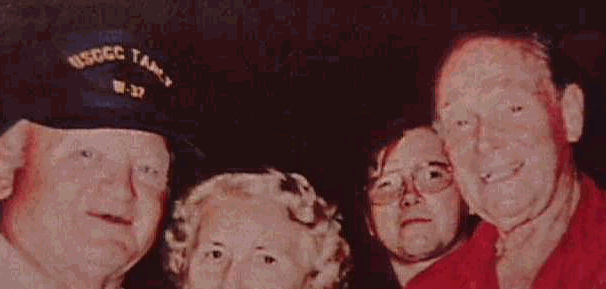
Taney Reunion Pear Harbor 1991
Harry Nelson (left) Taney Veteran
Capt. Koitschka (right) commander of German U-boat U616
Discuss hostilities between the two ships April 1944 in the Mediterranean
"TANEY was the flagship for Task Force 66 in the Escort for Convoy USG-38 IN THE Mediterranean in April of 1944 when the USS FECHTELER DE-157 and USS LANDSALE DD-426 were sub sunk by German submarine and air attacks. TANEY did some fast footwork herself to side step some torpedoes which sizzled close."
Article from "Pacific Shield" Honolulu, HI Magazine December 1991
A TANEY Man Can't forget Sunday December 7, 1941
"At 7:55 a.m. the alarm went off sounding general quarters and I started cursing because we had been having so many drills" recalled Chuck Sellentin, who was a 17 year old fireman aboard the TANEY Dec. 7, 1941, He had left his parent's small farm in Belden, Neb., less than a year earlier. Sellentin recalled a shipmate who came sliding down the railing into the engine room and yelled "This drill is for real. The Oklahoma is turning over! You can see the smoke coming from Pearl Harbor"
Sellentin ran up the ladder to his general quarters station which was on the main deck below the bridge. "I could hear all the excitement, and about that time I saw Japanese planes flying high overhead" said Sellentin.
"The next thing I heard was the shooting of our guns. That particular moment still stands out in my mind because the reverberation shattered all the glass windows in the nearby warehouse," he said . "some of it came tinkling down on the ship". Latter that morning while manning his general quarters station, Sellentin saw Japanese planes coming toward the ship. "One of those planes came in so low I thought I saw the pilot waving," recalls Selletin.
This was just one of many recollections that 16 former TANEY and retold to each other, and to active duty Coast Guard members and the media during the TANEY reunion held in Honolulu Oct 24-28.
A special highlight of the reunion took place Oct 25 when the former crew members and their wives were honored guest at the dedication of a TANEY historical marker. The marker, which includes a painting depicting the TANEY docked at Pier 6 as its crewmen fired on enemy aircraft, will serve to commemorate her actions on Dec 7, 1941.
The 16 Pearl Harbor survivors were joined by approximately 50 other former crew members who served aboard TANEY at various times during the cutter's 50-year career.
During the dedication ceremony, principal speaker and Pearl Harbor survivor Willis Partridge gave a stirring account of what happened when enemy planes appeared that morning. "At about 9 a.m., we could see planes very high and we could see they were Japanese. They were out of range of our guns although we fired at them. I think we broke up their formation," Partridge said.
Partridge was n 18-year-old signalman third class at the time. Pointing to the west, he said "five Japanese planes came toward us from that direction. They looked like they were coming in for a glide-bombing run on our ship or the power plant just to the northeast of Pier 6. Our gun crews fired everything we had at them including coffee cups." We didn't see didn't see how any of them got through our barrage. But the Japanese pilots must have concurred because they skedaddled and never came back," Partridge added.
Launched in 1936, TANEY was one of 101 ships stationed near Pearl Harbor on Dec. 7, 1941, when the US fleet was attacked without warning by the Empire of Japan. Until she was decommissioned Dec. 7, 1986, the TANEY was the last of those 101 ships still in active service. The battleship USS Arizona, resting on the floor of the harbor, however, still remains on record as "commissioned" as a memorial to the men who died.
In addition to attending the historical marker dedication, the reunion members and their wives were treated to a cruise and buffet lunch aboard the modernized 378 -foot Coast Guard Cutter Rush. After the ceremony they toured the Hawaii Maritime Center, and the Arizona Memorial.
Earlier in the week, 12 reunion crewmen paid a visit to Honolulu Mayor
Frank Fas's office where he issued a proclamation declaring
Oct. 25, 1991, as "Coast Guard Taney Day" in Honolulu.
Several years latter the plaque was moved to the Maritime Museum because of vandalism. The rededication ceremony was attended by Vern Toler and two other ex TANEY crewmen on Sunday the 7th of December 1986
Webmaster Vern Toler Coast Guard adventures:
Since pre school I always wanted to be a Doctor, Dr Davis my role model, but I never realized I would never have the !smarts! to be one. With the help of my brother Ira Toler, my hobby was photography, still and movie, which included processing our own film. My dream of adventure was to be a newsreel photographer and I would often go down town to visit the newsreel theaters. I enjoyed High School ROTC and wanted to enter the Army. The films of the German Airborne impressed me. I felt that America should be isolationist and we should build up our own military equipment since the two oceans would prevent any enemy coming here, after Pearl Harbor my views changed.
1943 My last year of High School, I was working as a "para-medic" on a ambulance with my friend Skyler Hixson, we both were afraid that the war would end before we graduated so we both went down town to enlist in the Army, there I saw a poster sahowing Coast Guardsmen rescuing wounded so I figured as an "ambulance attendant" they wanted me, also I figured it would be easier to get my mother to sign my papers if I mentioned Coast Guard. Skyler figured I was nuts, he joined the Army I joined The Coast Guard.
Boot Camp was at Government Island, Alameda, California. Two Movie stars were in my class, Ford and Gig Young. To my surprise I found out the Coast Guard did not have a Medical Service and their Doctors belonged to the Public Health Service, they didn't need my past experience and to my humiliation I was assigned to Guard Duty at Fisherman's Warf in San Francisco, California.
Finally after much begging I was assigned to "Sea Duty" The Cutter TANEY entered the shipyard to be retrofitted with 5"38 guns. I was assigned to a welder for "fire watch" duty, so I watched the welder and became painfully blind for several days after.
I will not attempt to use time periods on my TANEY story since my memory is week and I have found conflicts with other stories on this web page. It was a beautiful day when we left San Francisco and as soon as we left the bay we ran into the infamous "Potato Patch" where all of the "first time sailors" got sea sick. We headed for the Panama Canal and receive a lot of needed training along the way. The trip through the canal was impressive. The waters of the Atlantic and Caribbean were impressive. The waters were so clear and inviting I had a hard time resisting the urge to dive in to swim, the porpoises would swim with the ship and it seemed like they enjoyed our presence. At night the wake of our ship was phosphorescent to the extent you could read a book. One night while on watch a crewman approached me acting strange, after I started talking to him he woke up, He was sleepwalking, he knew he was a sleepwalker and he begged me not to tell anyone for he did not want to be put ashore. At another time in the Caribbean we ran into a storm, where many were seasick and topside. Many times a wave would come over and crewmen would be washed across the deck, but luckily no one went overboard. We reached Norfolk VA, where I went ashore as a Veteran with the Atlantic Service ribbon.
We left Norfolk and picked up the largest convoy ever assembled; this sure dispelled my earlier views that the two oceans protected us from any possible enemy. The first part of our trip we were covered by PBY aircraft, but soon we were our of range and on our own. One evening while on watch I saw what looked like smoke and flame on the horizon, finally my wartime adventure began, I quickly reported it to the bridge, and of course everyone else on watch heard my report, After a short pause the bridge informed me that what I saw was the moon rising through some clouds. Through the rest of the night someone would call through the intercom and say,"Hay Toler, how is that fire doing floating over head." As the command ship our ship would skirt through the convoy giving instructions to the merchant ships, we would instruct neutral ships encountered to get out of the convey path. Refueling at sea was quite an interesting feet. Our ships Doctor would board other ships by breaches bowie to take care of the sick, often he would get dunked. One time We picked up a merchant seaman from a troop ship and preformed an emergency operation, When he was well enough we returned him to his ship, sadly a couple days latter he and seven hundred others parished when a torpedo hit his ship, Our ships photographer caught the explosion on film and the picture was published in "Time Magazine".
I was able to become a hospital striker so my duties were in sick bay but general quarters was down below in the magazine, so when we had our action I again was disappointed since I could not see anything. Others have tolled the story better than I have.
One night I was called to the bridge to stand watch on the helm, two sailors on the bridge were drunk and smelled like shaving lotion. At their trial I refused to testify, I falsely thought that sailors should not testify against other sailors, for that I was introduced to cleaning the bilge's, I regret my actions for their behavior not only endangered thousands of sailors but the war effort as well, ironically I never smoked or drank and I still don't.
I would correspond with a High School friend of mine, Nicholas Villa, who I knew, was in the Airborne and was in Italy at the time. One day at Mail Call I noticed a strange look on the Mail Orderly face, he then handed me the last letter I wrote to Nick, on it was stamped "Killed in Action" along with a verification stamp.
Once we preformed an operation on a man's Piles, this was a stinking, painful operation and the next day I had to change his dressing, I said what I thought was proper, I said "this won't hurt" he quickly yelled back at me and stated "Don't tell me it won't hurt, I am an Officer."
Our Doctor, Kemp Dowdy, U.S. Public Health Service" was a Cherokee Indian, who worked his way through Medical School as a Boxer and Butcher. He was very intelligent, friendly and well liked. One evening while returning to the ship on an Officer Launch one of the Navy Officers was making bad remarks about Coast Guardsmen, Dr Dowdy went over and knocked him over board. The officer reported him as a Merchant Seaman boarding the Coast Guard Ship; it seems he did not know what the USPH insignia was. No one blamed Dr. Dowdy, especially since the day before he had boarded the Coast Guard manned DE, which lost its bow to a torpedo to care for her wounded. Many years later I contacted Dr Dowdy by phone, he still had a lot of salt left in him since he stated he had to go to surgery to burn off some barnacles from an old man, (The lasts time I went to a Doctor, that is what she did to me.) Dr Dowdy died a few months after that.
Chief Pharmacist Mate Quarles was quite an artist, He left the ship when it was in Boston due to problems with kidney stones. Several years later I obtained his address and wrote to him, his wife wrote back to me stating he had passed away.
Pharmacist Mate Smith was a professional piano player, one time in Boston at a USO I asked him to play something for me, reluctantly he went to the piano, and played a concert hall rendition of "Tea for Two" the quality stunned me and everyone in the USO, he then quietly walked away, and for ten minutes the USO was silent, I have often wondered what the others in the USO thought. One day while I was in the Navy in Santa Barbara a lady approached me and tolled me about a medical sailor who wrote her about her wounded son, she said the story was heartwarming and that his name was Smith from the Coast Guard Cuter Tandy, what caused our paths to cross I will never know, it is just that I was in uniform and had a red cross on my sleeve. One of our shipmates said he saw Smith playing in a Bar in Oakland California, but out side of that no one has ever heard from him.
We made three convoy trips to Tunisia, others have tolled the story better than I could. The ship photographer did not return so I took over his "Speed Graphic" and took many pictures, since they were unofficial I would pass them out to shipmates, sadly I did not record names, but I still have hundreds of 4x5 negatives, I also took movies with my own 16mm camera but most of the footage has faded. The ship was sent to Boston for its Pacific retrofit. The new doctor wanted only trained Pharmacist Mates and he ordered me to attend school, it was a difficult decision for me for I wanted to stay with the ship.
While working in a dispensary in Boston, a man was brought in by the Shore Patrol, he turned out to be a former TANEY man who bowered $50.00 from me in San Francisco to visit his sick mother, he then deserted, when I reminded him about the $50.00 he got angry.
Pharmacist Mates school was good and I learned a lot. While there one of our class mates became a hero when he took care of injured when a plain crashed into the Empire State Building, Many doubted much of his story but the newspapers latched on to it, it sure helped him since he was AWOL at the time. The war ended while I was at school, and since I was a veteran I was given first choice of my next station , I chose Chicago but another man gave me a sad story so I traded with him and headed for Savanna Georgia.
While at Coxsper Island Separation Station I worked as an x-ray technician, and again I took over the Station "Speed Graphic" I took flying lessons and often would fly over the station solo with the speed graphic at about 50 feet, to take pictures if the FAA knew my wings would be clipped. The First International Monetary convergence was held in Savanna, GA, as the Coast Guard was part of the Treasury Department we were in charge of its security, I took the Speed Graphic there, and obtained a press pass from the local news paper since I provided them with many pictures from the base, that combination gave me free run of the Conference and many of my pictures were published world wide. The Chief photographer of the Coast Guard arrived later and saw what I was unofficially doing, he liked my worked and stated that he was retiring and that if I would reenlist I could have his job along with two promotions, since I still thought I could become a Doctor I declined, an action that I regretted for the rest of my life.
One day the TANEY docked at our station on its way to San Francisco, I was permitted to join it with my motorcycle and went to San Diego where I was discharged.
After failing college I entered the Navy then Army to finish my military career as a Biomedical Equipment Technician. Which included four years in Vietnam with the State Department. While stationed in Fresno California a man read my name in the paper and contacted me stating he served with me on the TANEY.
After my first wife passed away estalgia began to take hold and I spotted a TANEY reunion in the VFW magazine. Latter I was able to attend the decommissioning of the TANEY, tears began to roll down my cheeks and I was embarrassed, until I saw a Chief and other crewmen with tears flowing as they departed the TANEY officially for the last time.
At a coast Guard Party at Kitchens house I was surprised to find that the chief security officer for the VA hospital I worked, was at the party and he was former shipmate.
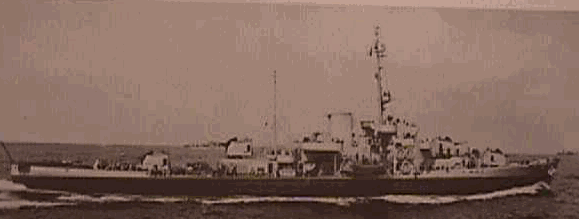
The following is from a pamphlet by Homer T. Compton, copied by Vern Toler Nov. 1998
The R.B. Taney
The R. B. Taney was a sexy gal
Her spar-painted masts so slim and tall
Helped her to be most admired by all.
Dressed in white down to her thighs,
Made her attractive to most of the guys.
We scraped her bottom, rusty or not,
Just to help her make an extra knot.
We watched over her at nigh, and scrubbed her each day,
We slept with and loved her
For all that she gave.
December 7, 1941
It was a long day for this Hawaiian cop. That evening, after a long, tiring and frustrating day, he headed for home. He stopped by his Japanese neighbor's house, knocked on the door, and shot him between the eyes. We never knew what happened to that cop. But considering the mood everyone was in by the end of that day, they probably gave him a medal.
(Webmaster note. Although the above is shocking, to leave it out would be re-writhing history, but the fear of that happing is part of infamous interment of the Japanese. S/vern)
Big Stoop
While patrolling off the entry of Pearl and Honolulu harbor, one of our 90 day wonders thought he would do a little fishing while on bridge watch. So he took a couple of heaving lines and with hook and bate, he threw it over the stern. The crew wasn't going to let him get away with that. So, they pulled in his line and tied a swab to it. Coming off watch, Big Stoop sees all this splashing at the end of his line, and he starts pulling it in. (He really thought he had something.) Pulling the swab up on deck, he sort of looked dumb-founded. But he came out of it, and as he walked off, we could hear him say, "Well, I guess it was a pretty good joke at that!"
Gilje on Watch
While on the 12 to 4 depth charge watch, headphones and all, Gilje remained alert. Big Stoop thought he would make the rounds, to see if anyone on watch was asleep. Arriving at the depth charges, he saw Gilje standing his watch. Big Stoop came in close, to see if Gilje's eyes were open. Failing at that, he stood out in front of Gilje and started waving his arms up and down. Gilje just looked at him for a minute, and then he said, "What are you trying to do, take off"
Making Captain
In 1941, rating for advancement came only when a vacancy occurred. We had this young fellow on the deck force, and he hated it. He really wanted to get into the carpenter shop. One day, he went to the section leader and asked if he couldn't be captain. Sure enough, the next day, he was made captain. He did such a good job that he got to stay for two months. I always thought it was good that the Taney had two captains, or we might have been in trouble.
Stopped at Night
One night, while cursing at about 10 knots. We; were coming from around Hollard Island, headed for Canton Island. All of a sudden, the Taney stopped, just as suddenly as if it had hit an island. Several of the men got rolled out of their bunks from the sudden stop. There were a couple of surges, with the rigging snapping back and forth, then we were off and going. There was no scraping of metal as if we had hit a sub, or coral, or rocks, nothing. But we must have hit something pretty solid to stop a ship the size of the Taney. At Pearl, we were able to put in to dry dock to check the hull. No marks. No scratched paint. Nothing. What could we have hit? Maybe---a whale?? The mystery remains unsolved.
On Guard
On guard at the entry to the pier where the Taney was moored, our sentry carelessly leaned his rifle up against a piling. A slight bump and the rifle fell into about a 35 feet of water. Talk about a worried sentry! No need to worry. Two men coming back from liberty heard his story. They stripped down and dove after it, retrieving the rifle on the third dive. The result? A Happy sentry who had to account for his rifle at the end of his watch.
All Secure
December 7, 1941. The first section was giving orders to get a machine gun from the armory, so that they could go out and secure a perimeter around the Taney. After about 3 hours, it was decided this wasn't necessary. In the meantime, the army had came by and placed a sentry at the head of each dock, with orders not to let anyone on the pier. As the first section came back to the pier, the sentry ordered them to halt and state their business. Getting back aboard wasn't going to be easy. But, after 15 minutes with our machine gun to back us up. We were able to convince the sentry it really was our ship.
Shipboard Romance
On our Alaskan cruise, the wife and I met a young lady, about 25-30 years old. She told us she was aboard hoping to find a good-looking man, about 30 years old, with a good job, etc. She said she had found one, but she wanted to check him out a little more, so we wished her lick. The last day, we happened to meet her again, and we asked her how she had made out. She said he checked out OK, he had a good job and income. The only catch was they were both looking for the same thing. A good-looking man, about 30, with a good job….
When the Lord
When the Lord was passing out sex, he gave man 20 years of time to sex. Man complained that he needed more time. But the Lord wouldn't relent. Then, the Lord gave the monkey 20 years. The monkey said he only needed 10 years, so man took the other 10. Then the Lord gave the Lion 20 years. The Lion said he only needed 10 years, so man took the other 10. Then the donkey got 20 years, but he said he only needed 10 years, so man took the other 10. And that's why man has 20 years of sex, 10 years of monkeying around, 10 years of lion about it, and 10 years of making a jackass of himself.
Aunt Harriet
Aunt Harriet asked her mom one day, "how old do you have to be before you stop thinking about sex?" Her mom, who was about 104 year old said, "I don't know, you better ask your grandmother"
Some of these stories are true. Others????? ----- Homer Compton
A SHIP'S DREAM
Old sailors come from far to see the U.S.S. Taney.
All in white is she, close by for all to see
and learn about her great history.
As she rises and falls with each tide,
You can see she still has lots of pride.
Old sailors moving around the ward
still talk about their years aboard.
Then she tugs and pulls against
her lines, as if to say
I've made up my mind
to take these old sailors back in time.
With the wind at my bow and wake at my
stern
we could sail to places and not return.
Not too fast and not too slow
we still have places we could go.
But as the chatter of these sailors cease
the Taney settles down as if at peace.
Oh the crews were great that sailed
with me
helping to serve this great country.
For getting old is not all it should
be
but I happy being moored here by the
sea.
BM1/c 1941-42-43
HOMER T COMPTON
The following "Stories by HOMER T. COMPTON no 1. Copied by Vern
TOLER
Nov. 1998.
Homer Compton tells how he joined the Navy.
In 1940 things were heating up in Europe and having put 3 years in
the Washington National Guard I decided I would rather do convoy duty on
the Atlantis. So I joined the U.S.C.G. and did my boot camp time in Port
Towsend, WA. As my time came to ship out, we were offered several places
to go. Believe me Hawaii sounded a lot warmer than the Atlantic in February
and so I was assigned to the U.S.S. TANEY. A few trips to check
on some of the equatorial islands and we were sent to Mare Island for refitting.
Two 5" guns, four 3" I guns and depth charges were installed and we sailed
again for Hawaii. Everything was peaceful so we thought. July 16,
1941 the Navy says "guess what -- you're in the Navy" and will get your
orders from the 14th Naval District. And that's where we stayed for the
rest of the war.
In 1942 we were in Pearl Harbor for some work and I was in need of
two turnbuckles to repair a lifeline around the boat deck. Having heard
the Signalmen had got some signal pulleys from a salvage dump, I headed
out to the dump. There was a pile of burned out turnbuckles - picked
out two and the yardman sand blasted them; to a nice bronze color.
As he handed them to me he said: these are off the Arizona. The Taney is
at Baltimore Maritime Museum. We have an on Board reunion in September
1995. So I'm going to have a look to see if she still carries two turnbuckles
off the USS Arizona. Homer Compton (They were gone.)
`2 HOURS OF HELL
Oahu was enjoying a peaceful Sunday morning December 7, 1941 when Japan started its air attract on the ships and planes at Pearl Harbor. As the bombs came raining down the ships at Pearl soon came alive. Then a bomb plunged through the deck of the Arizona to the magazine below. The explosion that followed shook the island of Oahu and the world. Fire and smoke filled the air and was seen for miles. In the wake of the attract 5 battle Wagons lay on the bottom.
The USS TANEY, moored at Pear 6 Honolulu, joined others in repelling their attract. With fire control selecting targets the TANEY keep up a continuos fire. Her guns became hot and smoke filled the air.
Hickam and Wheeler field were a mass of destroyed planes and hangers, some 150 planes were destroyed. Still the Japanese came in bombing and strafing then would bank against the rising sun for another attack.
Five planes coming in from the north started there attract on the Taney.
With all our guns blazing away at them they soon turned seaward with one
plane reported smoking.
With ready boxes running low, the magazines were opened and all the
boxes were soon filled. Clearing the deck of empty casings was soon completed.
Then we were under another attack. 3 Japanese planes came roaring up the channel so close you could see a big smile on their faces, happy with success. Our 50 caliber guns opened up with some hits reported. They soon disappeared.
With rifles and 30 caliber machine guns from below, The TANEY was ready for more attracts.
Eighteen ships were sunk or damaged, some 150 planes damaged or destroyed
and over 2,500 men dead. -- it was over. But it wasn't. This was
the start of a war they would last over 3 1/2 years -- from Pearl Harbor,
Midway, and Africa to the Phillipines, Okinawa to Hiroshima. The USS TANEY
was there all the way.
Homer T. Compton, BM1c
U.S.S. TANEY
Orders 0400 December 8, 1941
Search and destroy all enemy subs in the area of Honolulu and Pearl Harbor channels.
So after being at G.Q. all day the 7th and all night we moved out to
help 2 destroyers already working the area.
Any sound or contact made; we laid down a pattern of depth charges.
By midmorning there must have been 150 depth charges rolled off the stern
by the ships working the area.
About 1000 hours a heavy cruiser coming out of Pearl Harbor channel
signaled the USS TANEY "Torpedo headed for your port beam". The signalman
repeated the message to the occupation. Captain Olsen says "Could
that be for us?" A young quartermaster on watch says " Captain let's
not wait to find out, let's get the hell out of here" Captain ordered "Right
full rudder, full speed ahead" So we did. It was and it missed. Homer
T. Comptom
U.S.S. TANEY
Some months after the bombing of Pearl Harbor we were ordered to Midway to convoy a repair ship back to Pearl. As we left Pearl harbor we had to pass through a submarine protected. This area was for our subs to practice dives and practice their torpedo shots with our own ships as targets. The practice torpedoes, of course, were not armed and were set to go beneath the target ship. As we passed through the area on our starboard side about 25 feet out we could see this periscope eye balling us. Calling Pearl Harbor we asked if we had any subs in this area. The answer was negative. Now as we had passed by we had thrown an ! Egg Crate ! over to mark the spot. So returned to hunt the sub but by the time we got it cleared from Pearl Harbor and returned we could not find it. The Japanese must have thought this was some new kind of weapon and got the hell out of there. So we proclaimed to be one of the first ships in the Pacific to depth charge an enemy sub with an egg crate. Homer T. Compton
A LUCKY LADY
July of 1943 the U.S. was making plans to take control of
the Gilbert Islands. The U.S. S. TANEY was to take a 2 man survey
party aboard and proceed to Baker Island and check it out for use as a
possible emergency landing site for our airacraft.
We arrived at Baker about two hours before sunset. The 5" gun crew
aft was to make up the landing party (not knowing if the island was occupied
by the Japanese) Rifles and grenades were issued. The power launch
would tow the landing boat to the surf and then wait for their return.
My 5" gun crew forward would take charge of lowering and hoisting the boats
as they departed and arrived.
We were soon spotted by a Mavis Japanese bomber. Needless to say at
this point the landing was delayed. As our 3" guns put up a great amount
of flak, the Mavis lined up for an aft to forward run. Unable to
get us in their bombsights they circled for another run. We made
ready our guns and soon they were blazing away. Then the vapor streams
and bombs away. With full steam ahead and left full rudder we knew it was
a matter of seconds. Everyone that wasn't on a gun hit the deck. One 500-lb.
bomb splashed close on the port side. Another hit about 10feet off the
starboard, close to my battle station. The bomber circled and moved on.
Expecting more enemy planes we steamed for Palmyra Island. Two days
later we returned with 3 Army Ventura planes for air support. (No Japanese
were found on the Island)
Assignment complete we headed for Honolulu. The Taney again was a Lucky
Lady. Homer T. Compton.
MAN OVERBOARD
The USS TANEY was under orders to convoy the USS WRIGHT AV-1 to Midway.
The Wright was a sub tender.
About two days out we received the news that a huge naval battle was
under way at Midway __ June 4, 1942.
Our laundry was running about 24 hours a day - hot - a regular steam
bath. About 2200 hours Johnson stepped out of the laundry for a breath
of fresh air, taking a short stroll to the weather break and as he leaned
against the roll, his shoes being wet, he slipped and went over the side.
Keeping his cool he was able to get his feet against the ship and with
a big push he was out far enough to clear the propellers. He was sucked
under and then the wake was something to stay afloat in. No one on the
TANEY knew of the accident. Kicking off his shoes and shorts he could see
the TANEY disappear in the darkness. Conforming to Navy rules we
were running a zig zag course and the chances of the Wright passing close
enough to be heard was one in a thousand. But it came about 500 feet from
Johnson. Johnson a nice quiet fellow could see this was his last
chance. So he began to yell and cry for help.
The bow lookout aboard the Wright heard and reported it to the bridge.
Minutes later the Wright lowered a motor lifeboat, it went in the direction
of the cry for help. The first pass the boat went by but Johnson kept yelling
and splashing water. As the boat came close Johnson grabbed the gunned
and swung aboard. About 1/2 hour later the TANEY received a
call. "Have you a C. K. JOLHNSON aboard." The TANEY's
answer was affirmative. "Well we have him now and you can have him at Midway."
The executive officer aboard the WRIGHT gave Johnson some clothes.
The TANEY gave the bow lookout a War Bond. Johnson was a Pearl Harbor survivor,
passed away a couple of years ago (1993) but this experience he never forgot.
Homer T. Compton.
U.S.C.G. TANEY AND THE PACIFIC
Much has been said about the Service men lying on the beach; and playing
in the Hawaiian sunshine but that wasn't said about the men on the TANEY.
Early in 1941 on my second day aboard, we were on our way to
Baker, Canton and Palmyra Islands which were about as near the equator
as you can get. Canton is some 300 miles South of the equator, with watches
to stand and a ship to clean, we were kept busy (one thing I soon learned
was at sea our ship was expected to be spotless), a hard task to accomplish
in port with stores coming aboard and liberty parties ashore it didn't
leave a lot of time for doing the things necessary for a spotless inspection.
The TANAEY deck was white teak, so Holy -stoning and scrubbing
the deck was a daily thing. At sea we wore white shorts and shirts.
We sat on the teak to watch the eight o'clock movies. A spotless deck was
the word.
Coxswain Soares, a Hawaiian boy, was my Section Leader. On night
watches we would watch for the Southern Cross and test our skills of navigation
by locating the star's positions and telling time by the position of the
handle in the Big Dipper. Being a Hawaiian boy he must have inherited some
natural skills in navigating by the stars, for often he was real close
when checked wilt the ship's navigator.
Supplying these small coral islands was a challenge to say the
least. Two or three men were on each island. There job was to send the
weather conditions to Honolulu each week; this was done by the use of a
hand-cranked generator. No fuel for the fires so all their food was canned
and buried in the sand to keep cool. Fresh water was put in 50 gallon barrels
and floated ashore by lifeboats over the long breaking surf. Their
only shelter was a dugout in the sand and covered by whatever material
they could find that had washed ashore - and there wasn't much of that
in that part of the world. Most of these jobs were given to Hawaiian men.
Three to six months was as long as they were allowed to stay at one time.
After supplying the islands and exchanging men we returned to Hawaii for
next assignment.
We were sent to Vallejo, California for refitting - two 5" and
four 3" guns were added plus six 50 caliber machine guns and depth charge
racks on the stern plus sound gear and radar. We began to look like a battleship.
With all this done, on July 16, 1941 we became part of the Navy. Gone was
our beautiful all white ship and our white teak deck, all now painted a
battleship blue.
We left Vallejo with a ship that I thought was a dirty mess.
But before we reached Pearl Harbor she began to look livable. With all
hands working around the clock she began to look somewhat like a ship we
knew.
Soojie, our ship mascot, a small dog of undetermined origin,
was one of the first SPARS of the Coast Guard. She had been aboard the
TANEY for several years and had achieved the rate of BM1/C before the days
of the SPARS. Brought aboard by a seaman on shore leave, she soon earned
the respect of all hands. Even though she was just a pup at the time, she
soon acquired the routine of the ship and earned the rating of Seaman First.
She could run up and down the ship ladders faster than most of the crew.
Early in 19041 the TANEY was laying off the entry of Pearl Harbor.
Some official business was to be delivered to the 14th Naval Commander,
so the TANEY lowered the power launch. With an Officer and 3-man crew we
set off for the Pearl Harbor boat dock. Soojie had gone along as a lookout.
While the boat crew waited at the dock, Soojie went ashore in search of
another canine (looking for adventure). When the Officer returned, the
motor launch was off to the TANEY. It was soon discovered after arriving
at the ship that Soojie had missed the boat. The Skipper immediately ordered
the launch to return to Pearl Harbor in search of the only lady of the
TANEY CREW. Everyone was apprehensive. But arriving at the boat dock Soojie
was waiting for her ride back to the ship. She was put on report
for missing the boat. At a 'Captains mast she was restricted to the ship
for 3o days. One of Soojie's happiest times was when the ship was
allowed swimming parties. She liked to be first in and the last out. Swimming
was one of her better accomplishments.
After the Pearl Harbor attract, the firing of the guns and the
depth charges made so much noise and vibrations on the ship that Soojie
became a victim of battle fatigue and was transferred for shore duty. She
returned to the TANEY however and retired as Chief BM in 1948. She spent
her last years in a little white dog house overlooking Diamond Head and
the harbors of Olahu.
As a bow hook on the Captain's motor launch I soon discovered this
may not be an easy task for on the foresheet there was nothing to hold
on to. Once upon unhooking the hoisting block I looked up to see this 6
foot wave coming down the starboard side of the ship and with nothing to
hang on to I grabbed for the hoisting block. As the wave hit I did the
swan dive of the year. I was ordered aboard for dry clothes. Everyone was
laughing and having a good time at my embarrassment. Captain Olsen laughed
and asked how it happened, explaining he had missed it all. But then he
asked seriously "You can swim can't you?" Trying to sound somewhat normal
I answered with a "yes Sir".
One time while moored in Honolulu harbor the Coast Guard little
patrol boat came by checking the docks and one of the men threw an apple
core onto the TANEY deck. Believe me a big mistake. The word spread among
the deck force of the TANEY. I was B.M. of the deck but some how
they kept it from me. But all the crew had made a trip to the spud locker
and as the patrol came by again all the deck force was lined up and let
go with the spuds from the spud locker. The boat windshield was broken
out and messed up the boat good. The Captain got a call from the
boat basin. Captain Olsen had to investigate. I never knew how much he
knew about the apple core and spuds bus as B.M. of the deck he called me
to his quarters. I thought, Boy, What now. He says, "You know about the
throwing of the potatoes?" Me. "Yes Sir." Now could you name anyone of
the crew that threw them?" Answer "No Sir. I saw the spuds fly but to name
any one person, I couldn't." Believe me no more spuds were thrown that
day. Captain Olsen was considered one of the best skippers
that I served under.
In late 1941 when we were checking on some of the equatorial islands,
and much to the elation of the crew, we dropped anchor in Pago Pago lagoon
(Samoa). This was a whole new culture and tradition, far from anything
we had encountered. Peaceful and friendly. They seemed to enjoy life with
very little to do. Most of the grass shacks or huts had no sides and a
roof made of palm branches. Beds were hand woven mates from grass laid
over a fine bed of very small pebbles and a 4"round log with the bark removed
was used as a pillow. Fish, bananas, coconuts and poi seemed their normal
diet. Sometimes a pig for special celebrations. Elephantiasis was a common
ailment o most of the older natives. They kept busy, however, making rings,
mats, hula skirts, and beads from seashells. These they would sell or trade
to the sailors on the ships passing by. A small canteen and open air tavern
was available with canned meats from Argentina, knives and most things
needed for this way of life. Some of the women were bare to the waist with
sarongs covering their lower body to near their ankles. Most could play
guitars or ukuleles and do the hula or some native dance. Most didn't
speak English but did very well with hand signals and facial expressions.
Most all the crew came back aboard with a wide assortment of things they
had bought or traded for. Soon we hoisted anchor and left this beautiful
island. Swains Island was occupied by English people and a few Polynesians
and a grove that seemed to be bananas or coconuts. Due to the shallow water
and long susrf we could only get within about a mile of shore, but that
that didn't stop these island people. With canoes and outriggers they came
out to meet us with shell beads and all sorts of things to trade. They
would trade for most any kind of clothing. Dungarees were the hot item.
They would cut the legs off and make shorts of them and, of course, any
news of any thing that was news outside the island. Soon we had to say
Aloha (farewell).
Palmyra Island, with a small lagoon and narrow channel just north
of the equator, was being fortified by the Army. With two Officers, myself
and Soares as Coxswain, we headed for this small lagoon. As we neared the
island we looked out on the surface of the water where we saw a school
of mantra rays all stretched out enjoying the tropical sun. Looking again
there appeared to be about 20 of them with the largest being about 25 feet
across. I motioned to Soares and he slowed his speed. This must have
been a Sunday meeting for we soon noticed several tiger sharks (6 to 8
feet long) escorting us down the channel. I thought at the time any of
these mammals of the deep could capsize our launch if provoked and then
as we came to what I thought was the danger point these huge mammals, as
if by magic, disappeared into the deep. With a quite "Thank you, Lord"
we entered the lagoon.
Some 100 nautical miles NW of 'Baker Island, while on lookout
from the Crows Nest I spotted this small cyclone about 5 miles to the South.
It appeared to be 200 feet across and reached some 3 miles into the air.
As we neared it seemed that that water was being pulled up into this mess
of whirling air. Some 200 feet up a fine spray would break from this whirling
air and fall to the sea. Then the sun shining into this fine spray created
one of the most beautiful rainbows I had ever seen. After several minutes
it just disappeared.
As temperatures reached 120 degrees sleeping below decks even
with the blowers going became an impossibility. Nights found sailors
sleeping on the main deck. Hard, yes, but with a little sea breeze you
could catch a few hours sleep. hosing down the deck with sea water was
a great help but a very temporary solution.
As the aircraft carrier Enterprise moved out of Pearl Harbor
escorted by the TANEY and several of its own planes, we heard one of the
planes engine sputter and conk out - with the plane diving into the sea.
The pilot ejected. We lowered a lifeboat and rowed to the man floating
in the water with his life jacket inflated and parachute bellowing in the
breeze. Lifting him into the boat was not easy but by cutting the shrouds
on hi parachute we were able to lift him into the boat. Trying to
pump water from him was difficult as we moved to the TANEY for hoisting..
Then artificial respiration began, with no apparent injury he still did
response. So after 3 hours the doctor pronounced him dead. The percentage
of pilots who lived was small as most went down with their planes.
While patrolling around the entry to Pearl Harbor on a very dark
night, Pearl Harbor radioed us that a ship on the East Side of Olaha was
all blacked out and we were to proceed and identify it. Some
thoughts were that it might be an enemy ship putting men on the beach.
As we came within the 1500-yard range, barely visible on the eastern horizon,
was all blacked out ghosts looking ship. Our signalmen started their blinkers
and radio. But no answer. After several tries, our gun, No. 3, opened fire.
Our elevation was a little low and I am sure those people aboard heard
these shells as they passed over them. Ass the shells exploded we saw silhouetted
against the light the Stars and Stripes flying high. It didn't take long
for signalmen to get busy identifying themselves. With their engines repaired
we escorted them to Honolulu harbor.
The war with Japan was under way and we still had d3 weathermen on
Baker Island. Two men on Canton had been removed by a destroyer in
the area abut Baker had the most treacherous surf so the TANEY was assigned
the job of removing them. We got under were and arrived at Baker Island.
We soon made ready for launching. With the powerboat we would tow the lifeboat
out; to the surf. Then with 10 men on the oars and a coxswain on the tiller
they would wait for the smallest breaker and then row to ride it in.
This sounds easy, and as long as the stern of the boat is on the crest
of the wave and you are running true with the wave everything is fine.
But if you don't read the wave right and get a little sideways then your
life jacket is the only thing left to save you. This is what happened.
Luckily all men got to the beach and went about saving the boat and all
oars and gear aboard. Now we had 13 men on the beach with no food or water.
Prior to our arrival one man had been killed when a Japanese sub opened
fire and they had no place to hide. We patrolled around the beach all night.
The next day the surf was too high and risky. We decided to send another
boat with water and food. We towed another boat out to the surf and shot
a line in to the beach. With this line made fast to one end of the boat
and another to the motor launch they could pull the boat in as we played
out line. Being a double-ended boat helped and a happy bunch of guys waited
as food arrived. All day the surf ran high and wild. On the 3rd day the
surf was somewhat normal and we were able to bring the men aboard. It might
be noted here that many of these white coral islands have no vegetation
and are only about 6 feet above the sea level.
The battle of Midway was at its peak when we were nearing the
Island hoping to get a sub tender, the USS WRIGHT, into the small lagoon
as soon as the battle at sea was over. The Japanese and the U.S.
both had subs in the area. Evading these and keeping a sharp lookout for
enemy planes took long hours and good lookouts scanning the skies. Changing
course often seemed a good deterrent. Finally as the Japanese withdrew
it was safe for our sub tender to anchor in Midway's small harbor. Then
we were off searching the battle area for survivors - no success.
After mooring at Midway I was able to go ashore and observe the
damage. The men and equipment used in defending the Island were beat. A
small division of Marines and a few planes would soon have succumbed to
a Japanese landing. Only our victorious battle at sea prevented it.
With tow old, old Olsen ships (Pre World War One slow freighters) we
headed for Palmyra Island with a load of supplies for the Air Force. A
small airfield and a few Ventura fighter planes occupied the Island. At
4 knots it seemed forever crossing about 1600 miles of ocean. With the
freighter having engine problems and a cross-sea of about 4-foot swells
wasn't making for a good trip.
After arriving at Palmyra we received orders to proceed to Canton Island.
- A freighter was aground. Arriving at Canton a destroyer was patrolling
the area and was happy to be relieved of its duty and headed for Hawaii.
The Taney sent several men to help unload the President Taylor but this
didn't help much as a huge chunk of coral had pierced its hull and remained
inside.
While patrolling the area our sound gear picked up a contact.
Making a run we dropped depth charges. The results of the explosion was
a school of sharks about 6 feet long flying through the air.
With this task completed we went back to Palmyra and picked up the
two Olsen ships and went back to Hawaii. 72 days were involved in this
trip - the longest ever. The President Taylor was shelled and torpedoed
by the Japanese. Years later the President Taylor was cut up for scrap
by a salvage company in Portland, Oregon
(see news article at end of this story about the President Taylor)
Returning to Pearl Harbor some of us were over due for R&R. So
while the TANEY was in for minor repairs four of us got 3 days at the Royal
Hawaiian Hotel. With the USO, a couple bottles of Primo beer and the Waikiki
Theater across the street we had 3 days of relaxation.
We arrived at Midway to pick up our sub tender, the USS WRIGHT,
for its trip back to Pearl Harbor. We departed a few hours before
dark. As darkness was setting in, our soundman picked up a contact.
One long blast on the whistle and we started on our run. The sub tender
of 54,000 tons started bearing down on our starboard side. With several
blasts on the whistle and a sharp left we were able to avoid a collision
that would have sent us to the bottom. Clearly they had gotten the
signals mixed up. Having missed a collision by about 20 feet was
close enough. Thank you Lord.
These were only some of the assignments that kept the TANEY and
us busy during the first part of our conflict with Japan. The TANEY was
nicknamed "THE LUCKY LADY" and the legacy lives on. Homer
T. COMPTON BM1/C
This is an excerpt from a TANEY related history. S/vern
"Portland Salvers Cutting up War-Lost Vessel"
BY LAWRENCE BARBER, Marine Editor, The Oregonian.
"A crew of Portlander's who sailed in the 140-foot yacht Caronia from Portland in August, 1943, for Canton Island to salvage the wrecked steamship President Taylor, where it stranded on the mid-Pacific coral island."
"The President Taylor was a former American President line ship which
was operated as a troop transport during the early days of World War 2.
According to the most reliable version told at Canton about her stranding
there, the ship called there February 13, 1942, with 1200 troops to be
disembarked in small boats. Before the troops were able to leave
the ship, however a destroyer escorting the Taylor reported submarines
in the vicinity and instructed the transport to stand in closer to shore."
"Ship Held Fast"
"While maneuvering, the ship touched bottom and heavy swells drove
her hard aground. The destroyer was busy dropping depth charges and
unable to assist the transport. The next day the troops were disembarked
and some of the cargo jettisoned to lighten; the vessel. Two unsuccessful
attempts to re-float the ship failed and she was ultimately abandoned.
"
A had written note on the article states: "After the TANEY arrived
the Destroyer left. It was reported the destroyer Captain told the
Skipper of the U.S. Taylor to get in closer or we leave you. The
Skipper of the Taylor Shot himself the next day."