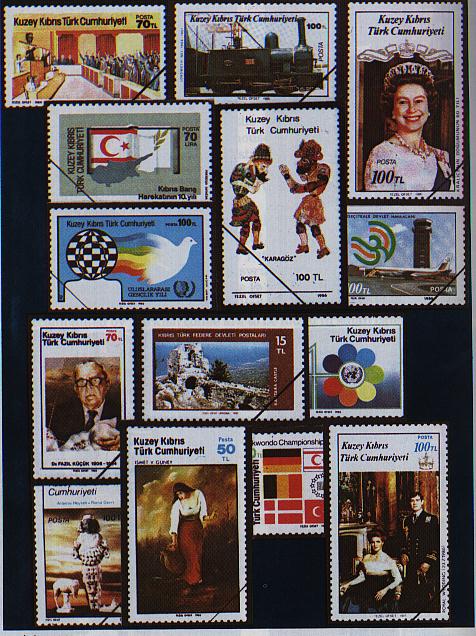
NORTH CYPRUS STAMPS & POSTAL SERVICES:

Turkish Cypriot stamps of Northern Cyprus is one of the
most sought after stamps in the world today, due to the
international status of the country, and the peculiarities
of its situations. Below is given the historical account
of the development of the Turkish-Cypriot Posts, by Jeff
Ertughrul, whose article appeared in the Stanley Gibson
Magazine.


ESTABLISHMENT OF THE TURKISH-CYPRIOT POSTAL ADMINISTRATION:

Peace did not come to the island with the independence, in
1960, from Britain. Fighting between two communities broke
out in December 1963 and, within months, a de facto separation
of the two peoples had emerged with the Turkish-Cypriots
concentrated in a number of enclaves scattered throughout the
island.

The simplest way to study the resultant Turkish-Cypriot postal
services is to examine them stage by stage. The postal services
were commenced on the morning of 6 January 1964. Post Offices
in the Turkish sectors of Famagusta, Larnaca, Limassol, Paphos,
Kyrenia and Lefke were opened on the same date, although there
was little postal activity in and around Nicosia.

The Turkish-Cypriot Administration introduced a handstamp on the
same date to cancel ordinary Cyprus adhesive stamps with the words
"Kibris Turks Postalari" (Turkish Cypriot Postal Services).As the
bulk of the Republic's stocks of stamps were held in Ataturk Square
post office there was no lack of supplies. The handstamp had a fixed
commemorative date 6.1.64 at the base of the design. The Administra-
tion also introduced a second type, which had a star in place of
the date. Although the same types of handstamp were used in all
areas, they are distinguishable due to their having been handmade;
the imperfections identify the towns where each was made. Table
below shows Kibris Turk Postalari cancellations that have been
definitely identified.


-----------------------------------------------------

Table of identified `dated' and `star' Kibris Turk Postalari
Cancellations:

TYPE		OFFICE		SPECIAL CHARACTERISTICS

Date		Nicosia		Date close to inner rings

Date		Nicosia		Date more central between the rings

Date		Nicosia		A gap between B and R, in KIBRIS

Star		Nicosia		Bar under I, of POSTALARI

Star		Nicosia		No bar

Star		Nicosia		Large bar under I, rings incomplete

Star 		Famagusta	KIBRIS, in small thin letters

Date		Famagusta	Smaller, clearer lettering, than Nicosia

Star		Larnaca		Dent in outer rings just past POSTALARI

Star		Limassol	Small clear lettering consistent all
				round

Date		Paphos		Break in inner circle under O, of
				POSTALARI

Star		Lefke		Thick, mushy cancel, material too soft

Star		Kyrenia		Prepared but never used


------------------------------------------------------------------

I. POSTAL EMBARGO: (6 January, 1964 - 14 October, 1970)

During this period, the Greek Cypriot postal administration forbade
any post to and from Turkish-Cypriot areas, including their postal
agencies. Philatelists often had their letters returned handstamped,
noting that the agency was `not known'. Turkish-Cypriot overseas
mail went via Red Crescent, Red Cross, British Forces Air Mail,
United Nations Forces Air Mail, or the diplomatic bags of friendly
embassies.

One exception was the enclave of Famagusta and its 33 villages. The
Turkish town of Famagusta dominates the harbour; the Greeks needed
the harbour and the Turks, the Postal Services. In spite of the
trouble all over the island, Greeks and Turks carried on working
together in the port and consequently post moved unrestricted in
this area. Covers from this period especially with GR, ER, and VR
cancellations are worth looking for.

On 14 November 1964 a postal agreement was signed between the Greek
and Turkish Cypriots with the aid of UNFICYP (United Nations Forces
in Cyprus). According to this agreement all stocks of stamps and
stationery held at Ataturk Square Post Office and all money received
from these sales would be handed back to the Greek Cypriots. In return,
the Greek Cypriots would allow ordinary and international mail to and
from Turkish Cypriot areas and enclaves. In spite of this agreement,
the service remained restricted and covers from this period are very
rare.


II. POSTAL SERVICES: (8 April, 1970 - 20 July, 1974)

By April 1970 two parallel postal administrations existed side
by side. Therefore, Cypriot Philatelists were not surprised when
on 8 April, 1970 the Turkish Cypriot Postal Administration issued
two stamps for internal use. The currency, although in mils, was
shown in petals and each petal equalling one mil. These stamps
were cancelled by a line canceller generally in black ink,
sometimes in blue, with the datestamp of the post office applied
clear of the stamps.

On 29 October, 1973 the administration released seven values to
celebrate the 50th anniversary of the Turkish Republic. Along with
the new stamps, new postmarks were introduced in Turkish. The
cancellations are the type normally used in Turkey, a single ring
datestamp with date / time group in a straight line across the
centre. The office name at the top and the code letter at the base.

To enjoy a very limited postal communication with the outside world,
the Turkish-Cypriots had to follow the Greek Cypriot regulations and
handle mail in the usual way, but within their sealed off communities,
the local post operated, covering the whole island except for Turkish
Cypriot villages which were isolated within the areas of Greek Cypriot
control.


III. A NEW ERA: 1974 and ONWARDS

The EOKA-B coup, which temporarily deposed the administration of
Archbishop Makarios, broke out on 15 July, 1974. After frantic
diplomatic action between the three guarantor powers (Britain,
Greece and Turkey), Turkey intervened on 20 July by landing troops
from the sea at Kyrenia and parachute forces throughout the northern
Nicosia plain. Eventually the island was divided by the so-called
Green line and new post offices appeared throughout the Turkish
Cypriot Northern Cyprus, at Guzelyurt (Morphou), Lefkonuk (Lefkonico),
Kyrenia (Girne), Lapta (Laphitos), Iskele (Trikomo), Yenisehir-Nicosia
(Nicosia BO 4), and Degirmenlik (Kythrea).

At the same time, the offices at Larnaca, Limassol and Paphos were
closed by the Greek Cypriot administration who had taken over the
Turkish Cypriot quarters in these towns.


IV. THE NEW REGISTRATION:

The next important development was registration. Of the covers
which passed through the registered post system in these early
days, when the registration slips were still of the Republican
type but with Turkish style cancellations, the rarest are probably
those with Kyrenia registration slips, but with Lefkosa (Nicosia)
postmarks.

One of the newer offices opened by the Turkish Cypriot Postal
Administration -Degirmenlik- started the next phase in the story.
Early in January, 1974 it was issued with a rubber handstamp
roughly 33 mm long and 12 mm wide. This was divided into two
sections, with the upper left blank for the town name in manuscript
and the lower with a capital letter R and the item number. By the
end of April, all post offices in the Turkish Cypriot zone were
issued with new style registration handstamps, normally (38 mm x
10 mm) showing the town name used in conjunction with a second
(45 mm x 13 mm) containing the registration symbol and number.
During this period, the new office opened at Yenisehir-Nicosia,
initially the registered handstamp was accompanied by the town
name in manuscript, but by the beginning of June, 1975 both
Yenisehir and the main Nicosia proper had been issued with new
registration handstamps (45 mm x 12 mm) containing the town name
and registration mark combined. In these two cases, the R symbol
was on the left, the town name on the top, and the registration
number at the bottom of the strike. Rarest item in this `rubber
stamp' period is certainly the Lefkonuk (missing F) rubber stamp
dated 12 April, 1975.

By the end of June, 1975 the temporary rubber stamp period had
drawn to a close and all post offices in the Turkish Cypriot
Northern Cyprus had been issued with standardised, printed
registration labels. But what a fascinating period of development
for any postal historian to work on.


V. NEW VILLAGE HANDSTAMPS:

On 27 July, 1974 the Turkish Cypriot Postal Administration
requested new postmarks for 146 villages from PTT of Turkey. The
Turkish Republic Post Office agreed to make the new handstamps in
their workshops as a gift to Turkish Cypriot Postal Administration.
The new handstamps were the type used in Turkey dated in Arabic and
Roman numerals. The Director of Posts Mr Hasan Fedai, and his
assistant Mr Aysel Erduran, went from village to village teaching
the agents how to use the new headstamps. The issue of the new
headstamps was very well organised with advance publicity. Also to
lessen the burden, both of collectors and on the administration, it
was decided that the postmarks would be issued in three stages,
Lefkosa (Nicosia) district was issued on 1 August, Magusa (Famagusta)
district on 8 August, and Kyrenia (Girne) district on 15 August. Two
villages in Famagusta and some villages in Kyrenia were shown as
being under Nicosia, and two villages of Nicosia have been shown
under Lefke. Apparently this indicates the destination of the village
post not the administration district. In Famagusta, half of the
villages were shown as Magusa, and the other half as Gazi Magusa,
a title conferred on the town in recognition of the bravery of its
inhabitants during the 1974 war. However, it seems that some of the
headstamps were prepared before the honour had been bestowed on the
town. The village of Pile (Pyla) is unique; this village has two
headstamps and two agencies, each controlled by their own administration
(Greek and Turkish).


VI. TURKISH CYPRIOT POSTAL SERVICES: (1975 - To Date)

Since 1975, the Turkish Cypriot Post Office has managed to hold a
stamp issue policy of four to five commemorative sets a year, mostly
covering Cypriot themes with one or two exceptions. Credit must go to
the former Director of the Posts, Mr Hasan Fedai, and Mr Aysel Erduran,
both ex-officers of the old colonial and republican post office days.
Also their British training has been invaluable in developing Turkish
Cypriot Postal Services.

Among the best issues of North Cyprus since 1975 have been:

- the Tourist issue, 1975;
- Turkish Monuments in Cyprus, 1977;
- EUROPA, 1978;
- Historical Monuments, 1980;
- Flowers, 1981; and
- Flowers, 1982;

Slogans have also been kept to a minimum of four to five a year.


A SUGGESTED FRAMEWORK:

Those wishing to build a collection of material relating to the
Turkish Cypriot Postal Administration and stamps of Northern Cyprus
might like to follow the following guidelines.

- 1964 (January to September): Kibris Turk Postalari headstamps.
- 1970 to 1974: Social Aid stamps, Turkish Cypriot Revenue stamps
	        used postally.
- 27 July 1974 to 13 February 1975: Red Cross, Red Crescent postal
		services, autonomous Turkish Cypriot Administration
		stamps valid in the North Cyprus and international mail.

- 13 February 1975 to 14 November 1983: Turkish Federated State of
		Cyprus internal and international mail.

- 15 November 1983 to day: Turkish Republic of Northern Cyprus
		internal and international mail.


From: Jeff Ertughrul, `Postal Services of Northern Cyprus', in
	Stanley Gibson Magazine, June 1990.


.